October 7, 2026

Closer Isn't Simpler How Do You Move Closer Without Adding Complexity?

What Nearshoring Means for Automotive Logistics at the U.S. -Mexico Border

Mexico has become increasingly important to North American manufacturing, and the scale of trade moving between the two countries continues to grow. U.S.-Mexico trade reached a record $94.8 billion in July 2026, up 27.5% from the same month a year earlier.

More trade does not necessarily mean more flexibility in the network.

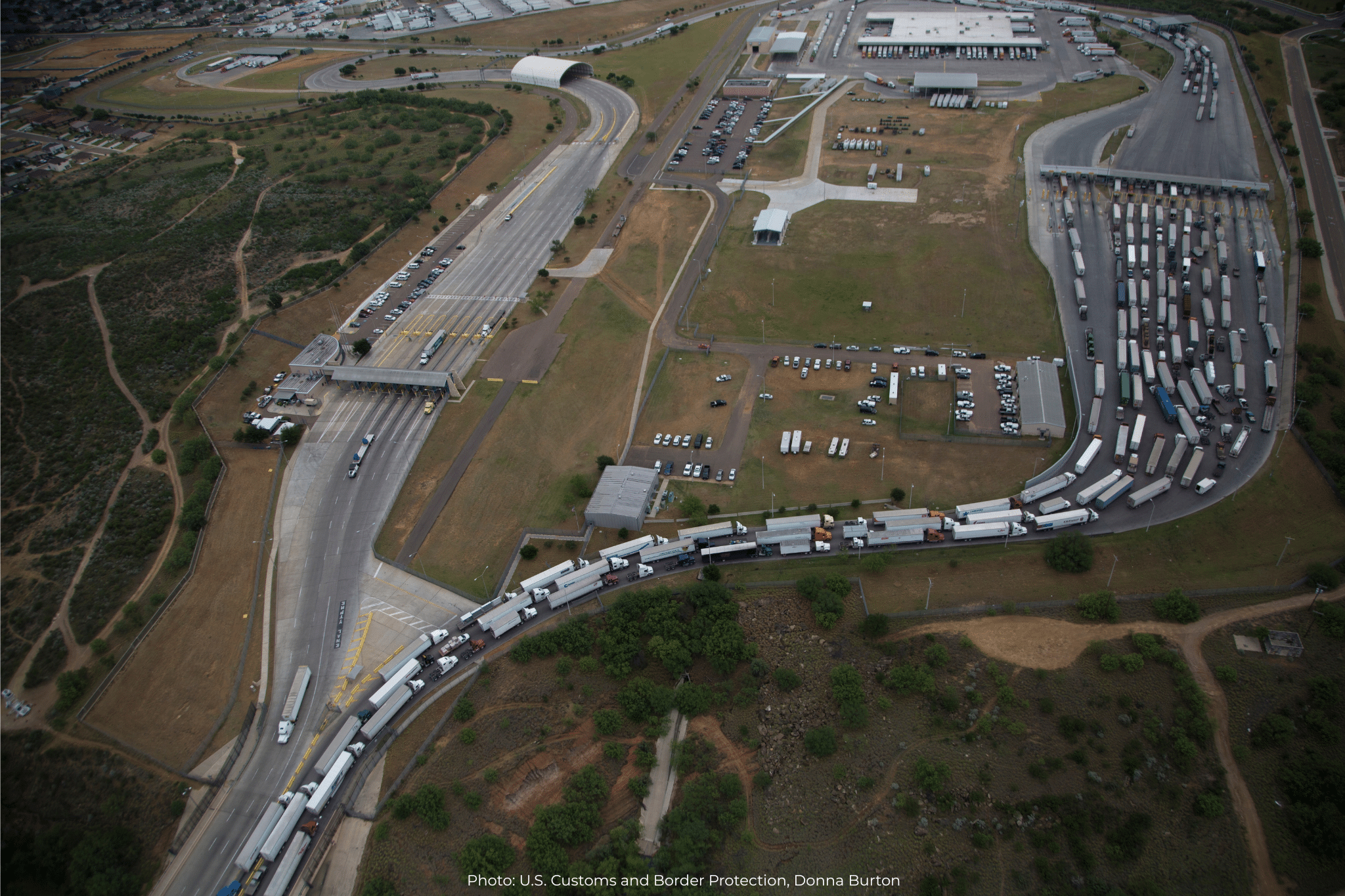
In that same month, Laredo handled $36.95 billion in two-way commerce, close to 39% of all U.S.-Mexico trade and its strongest July on record in data going back to 2013.

For automotive manufacturers, moving production closer to the U.S. market shortens the physical distance between factory and customer. It also places more weight on the infrastructure, capacity and information connecting those two points.

The route gets shorter. The planning does not.

Read More: FreightWaves, Noi Mahoney (9/10/26), reporting U.S. Census Bureau data analyzed by WorldCity

Border Capacity Is a Planning Input

A crossing can handle a tremendous amount of freight and still become a constraint when demand changes faster than capacity does.

Laredo's outbound tender rejection rate reached 15.19% on August 12, against roughly 3.32% a year earlier. The measure reflects the share of contracted truckload requests that carriers decline.

For a finished vehicle network, that shifts the planning question. It is not how far the vehicle has to travel. It is whether capacity will be available when the vehicle is ready to move.

A border delay becomes a scheduling problem. A scheduling problem becomes a yard problem. A yard problem reaches the next move in the network.

Read More: FreightWaves, Noi Mahoney (8/12/26)
The Network Is Only as Strong as Its Handoffs

Nearshoring also changes where the handoffs happen. Vehicles and freight cross borders, change custody, move between facilities and enter domestic transportation networks. Each transition is another point where information has to move with the freight.

Knowing where a vehicle is matters. Knowing when that information was last confirmed, who confirmed it and what condition the vehicle was in can matter more.

When something is delayed, damaged or held, the last confirmed handoff is where the investigation begins. That makes visibility more than a tracking exercise. It becomes part of how an operation responds when the plan changes.
Routing Is Becoming a Compliance Decision

The physical route is only one part of the equation. The U.S.-Mexico-Canada Agreement is under joint review, and automotive rules of origin are being examined directly.

The U.S. International Trade Commission opened investigation 332-608 in February 2026, examining the economic impact and operation of those rules and whether they remain relevant given changes in automotive production. A public hearing is scheduled for October 14, with the report due to the President and Congress by July 1, 2027.

Sourcing and transportation are connected through that process. Where a component comes from affects how it is classified. Classification affects documentation. Documentation requirements influence how freight moves through the network.

The transportation plan cannot sit entirely apart from the information about the freight itself.

Read More: U.S. International Trade Commission, Inv. No. 332-608 (2/19/26)

Nearshoring Changes the Question

The appeal is easy to understand. Move production closer to the market, shorten the distance, reduce exposure to long ocean lanes.

A shorter route does not automatically create a simpler network. It shifts the pressure somewhere else: to a border crossing, a carrier market, a staging yard, a customs process, or the information connecting each handoff.

For automotive logistics, that changes the planning question. It is no longer how far this vehicle has to go. It is how well the network performs when something changes.

That is where capacity, visibility and people start to matter. Nearshoring moves the factory closer. The logistics still have to connect everything in between.


Key Takeaways
Sources
1. FreightWaves, Noi Mahoney, “US-Mexico trade smashes monthly record at nearly $95B” (September 10, 2026), reporting U.S. Census Bureau data analyzed by WorldCity. Cited for July 2026 trade totals and Laredo volume: freightwaves.com
2. FreightWaves, Noi Mahoney, “Mexico tops US trade rankings in June as Laredo handles $36.5B in freight” (August 12, 2026). Cited for Laredo outbound tender rejection rates: freightwaves.com
3. U.S. International Trade Commission, “USMCA Automotive Rules of Origin: Economic Impact and Operation, 2027 Report,” Investigation No. 332-608 (February 19, 2026). Cited for the scope and schedule of the review: usitc.gov

Contact us to decide what customized solution is right for you!

About Us

A privately held joint venture between APL Logistics® and Fujitrans Corporation,® VASCOR is infused with expertise that comes from our connection to our owners’ global supply chain solutions.

})